
Can you recommend a good fishing
database for my PC? Where can I find a list of European line
class records? When's the best time of year for Madeira marlin?
Spike is here to answer all your fishing questions. Just email
your question to Captainspike@Leadertec.com
Hi
Spike,
Firstly, thanks for the description of how to make
a double line using the Australian plait. I have never
been able able to tie a good Bimini twist and I now
find the plait much easier to tie. I fish for Nile Perch
in Lake Victoria, Uganda. We mainly troll Rapalas for
fish which reach about 110 kg (about 240 lb). Nile perch
don’t have sharp teeth so we don’t need
to use a wire leader, but we do use monofilament leaders
around 100 lb breaking strain and about three feet long.
We generally attach the Rapalas with a snap swivel and
it doesn’t seem to affect the action much (well,
we still catch fish) although Rapala recommend using
a knot such as their own Rapala knot.
I have two questions: 1) How should I join the double
line to the leader; swivel or snap swivel, a knot, loop
to loop, something else? 2) What do you think about
attaching the Rapala to the leader with a snap swivel?
We do this to be able to quickly change lures when needed.
Happy fishing Hannes Visagie–
Lake Victoria, Uganda
Hi
Hannes
It’s generally recommended
that you don’t attach lures with a snap swivel
because the weight of the swivel can interfere with
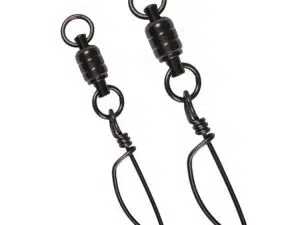
the action of the lure. I would attach a ball bearing
swivel to the double line using an Offshore
swivel knot (Cat’s paw) and either crimp or
tie the leader to the other side of the swivel.
The fish seem to be telling
you that they don’t mind the swivel close to the
Rapala, but it’s possible that you’d catch
more or bigger specimens without the swivel. Bearing
in mind that you need to be able to change lures quickly
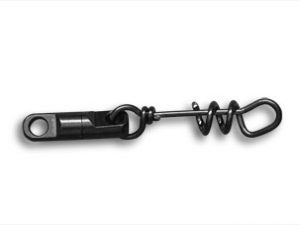
I think that I would use a Coastlock
or Duolock
snap without a swivel either crimped or tied to the
leader. This will enable you to change lures quickly,
but will have less effect on the action of the lure
because it is lighter.
-Spike
Dear Spike,
I fish the East coast of Australia for marlin and tuna.
I generally use a double line formed with a braid, and
attach the swivel to the double with a cat’s paw.
Last season I lost a very large Black marlin due to
one of the double lines breaking near the swivel allowing
the line to drag through. What would be a good alternative
to a cat’s paw to connect my swivel so that in
the event of one side of the double breaking the other
will remain connected to the swivel?
Cheers Jeff Sear – Australia
Jeff,
it’s always a blow to lose a good fish, and sometimes
it happens despite any amount of preparation. The cat’s
paw or offshore swivel knot, is probably the best for
joining a double line to a swivel as no cutting of the
line is required and it maintains the integrity of the
loop.
However, like all knots,
it needs to be well tied and be formed with the appropriate
number of turns for the breaking strain of the line.
Check the description of the cat’s
paw for the correct number of turns. As a general
rule, the lighter the line the greater the number of
turns required to tie a sound knot. Also don’t
forget to lubricate the knot and apply as much force
as is necessary to snug it down tightly.
Don’t worry about it
breaking, if the knot gives way when you’re pulling
it would definately have given way when a big marlin
pulled on it!
I’m just getting into offshore trolling and have
heard of tag lines off outriggers. Could you please
explain them and how they are rigged? Thanks in advance.
Ralph Knutsen
Hi Ralph
Tag lines are lengths of
line that run from the outriggers. Used almost exclusively
for fast trolling with artificial lures, their purpose
is to reduce the drop back that occurs when a line is
run from the rod tip to a standard outrigger clip setup.
Tag lines are not necessary when trolling with live
or rigged bait, and some experienced skippers believe
that the drop back from a standard outrigger clip set
up is beneficial even when trolling with artificials
as the fish has a little more time to properly take
the lure. However tag lines are popular amongst many
lure fishermen and with the appropriate hardware, easy
to set up and use.
Most crews use tag lines
that are roughly the length of the outrigger. The tag
line is tied to a ring on the halyard, or one of the
attachment rings of a standard rigger clip, and passes
through a weighted tag line return which runs freely
on the outrigger halyard enabling it to slide up and
down both the halyard and the tagline itself. When the
tag line is set the drag of the lure causes the return
weight to rise up the halyard allowing the tag line
to do its job. But when a fish strikes, and the strain
is taken off the tag line, the weight drops down the
halyard bringing the tag line with it.
The actual material of the
tag line varies depending on the preference of the captain,
but most boats in Madeira seem to prefer light tag lines
of approximately 150 to 200 lb mono or Dacron. Traditionally
the fishing line was connected to the tag line by way
of a rubber band which was wrapped several times around
the fishing line and tied to the tag line with a slip
knot. When a fish hit the lure, the rubber band snapped
and the fish's weight was taken on the rod and reel.
However, this system is fiddly to remove when lines
must be reeled in quickly during a big fish strike.
Some crews use large brass
clips as connectors, but these can be dangerous as they
tend to slingshot on the strike and can cause damage
to the boat or injury to the crew. An improvement which
I first saw used on board Captain Ron Cowling's OUR
MARY at Funchal is to crimp Black's outrigger clips
on the ends of the taglines. These light plastic pin
style clips connect to waxed thread or Dacron loops
attached to the fishing line. In use, the clip is simply
snapped into the loop. It works like a dream during
a hot bite and in my opinion is definitely the way to
go when using tag lines.
Take a look at the sketch
and see how the tag line, in green, from the left outrigger
(A) has greatly reduced the drop back from the rod tip
compared to the right outrigger (B) which has the fishing
line attached to a clip at the end of the rigger in
the usual way.
-Spike
Hello Spike,
I would appreciate your help with this. I’m confused
about the leader and knots, swivels, hooks etc. for
tarpon. Can you tell me which is the best lure, also
how to make a suitable leader, should I use swivels?
And how long should I make the leader? Thanks.
Victor J. — Puerto
Rico
I asked my good friends,
Captain Ed Williams, Captain Vic Tison, and Captain
Tony Wulf, all of whom fish for tarpon in Florida for
their opinions on this one. These are their suggestions...
Captain Ed Williams
— Fighting Lady Charters:
I would suggest that Victor
use the following: 3 to 4 feet of double line (use either
a Bimini Twist or a Spider hitch to create the double
line). Attach about three feet of 50 to 60 pound leader
to the double line with an Albright Special knot. Attach
the hook (if you’re using bait) or the plug to
the leader. I tie just about everything with a loop,
it will always catch more fish. I like the Mirrolure
88M in red and yellow, the 66M18 Mirrolure, the M52
and the Bagley Sinking Finger Mullet. If I am using
a live bait I size the hook to the live bait (normally
about a 4/0 live bait hook). I am not a fan of swivels
-they can be used. I would attach my swivel to the main
line and tie several feet of leader (60 pound) then
the hook or plug. If you are casting you will need to
use a shorter leader so that it is easy to handle and
cast.
Captain Vic Tison —
Vic2fish & Adventures:
If you are fishing in the
creeks then troll in the outside bends where it is deeper
and then stay in the deeper areas in the straight-a-ways.
I use live mullet, dead mullet which I cut to release
the oil or cut 1/2 mullet seems better at times and
also crabs and live or dead cut pogeys. Use as small
a weight as possible to stay close to the bottom or
even on the bottom. If you have to use a large weight
then tie it on your line with a rubber band so when
he makes his jumps the weight will break off and it
won't cut your line. One of the biggest mistakes people
make is to thread a barrel or egg weight on the line,
and then when he jumps, the weight slides up and down
on the line and cuts him off. Use a 60 lb to 80 lb swivel
then a 100 lb leader no matter what pound strength line
you are using. Leader should be 4' to 5' in length and
at the end use at least a 4/0 Eagle Claw Wide Bend Lazor
Sharp hook or another very sharp hook. A tarpon's mouth
is hard and I usually sharpen even my new hooks to penetrate
the armor hard mouth they have. That’s another
reason for the strong leader, their mouth is rough and
hard and when you hook up you don’t want to lose
him to a scraped up leader while he's jumping. If you
are fishing in the ocean or mouth of an inlet, use the
same rig, especially use the rubber band on the weight
in deep water. But if you see them rolling, (which you
usually do if they’re around) drift a mullet or
crab bait at the surface. The crab won’t stay
at the top like the mullet will but if you are drifting
or trolling it will stay up in the water column where
they are swimming also. Oh yes, the knots, I always
use a Palomar knot on the swivels and hooks. It's small,
easy to tie and will not slip with braided or mono line.
Captain Tony Wulf —
Splashing Tail Charters:
To start with, make sure
you have a heavy action rod, and a large enough reel
to hold about 200-250 yards of 60 lb line. This is what
I use to catch tarpon up to 80 lbs with, that’s
about as big as they grow in my area. Tie about 3 ft
of 80 lb leader to the end of the 60 lb main line. I
currently use PowerPro line. This line has a small diameter
which allows farther casting and stronger line in less
line diameter. The leader line and the main line should
both be tied to a barrel swivel rated to 80 lbs to prevent
breakage when using most artificial baits to prevent
line twist and unwanted wind knots. As far as lures
and baits to use, I would recommend checking with your
local bait & tackle store to get recommendations
for what is best to use in your particular area you
plan on fishing. Their are so many different bait fish
in the waters around the world, what I use here may
not work as well where you are. Check with the locals.
As for knots, I use a Loop knot when using most artifical
lures that need to move more freely, when they don’t
need as much action I use a Uni-knot. When using live
bait I like to Snell the hook to the line. When tying
a leader directly to the main line without a swivel,
I like to use a Double Uni-knot.
-Well Victor, you’ve
heard it from the experts. Although they all have personal
preferences their basic rigs are similar, and there’s
plenty of good advice to get you started tarpon fishing.
Be sure to let me know how you get on, and send me a
picture of your catch. If you want to find out more
about fishing with any of our expert captains check
them out in our International
directory pages.
-Spike
I'd like to keep a record of all my fishing trips on
my computer. Can you recommend any good fishing database
software?
Gary Tanner - London, England
The best fishing database
that I've found, and which I use myself, is called Fishbase
by Terrafin Software in California. You can keep logs
of fishing trips, catches, fishing spots, tackle maintenance
and fishing buddies. The enhanced version, Fishbase
Deluxe, also features a boat maintenance schedule which
is a great feature. Jeff Gammon who owns the company
is a keen fisherman and a great guy. Check out their
website www.terrafin.com
-Spike
What is the best knot for tying new line to a reel
spool?
J.Sevell – USA
The best and easiest knot
for tying new line to a spool would be the Uni knot.
Take the line around the spool, then take the tag end
around the main line and tie the uni. Click on the image
for some simple instructions.
-Spike
Here in Portugal we catch good numbers of white marlin
between June and September. I need to know where I can
find details of all the European records, can you help
me?
Luis Nabais – Olhao, Portugal
European all tackle and line
class records are kept by the European Federation of
Sea Anglers (E.F.S.A.). You will find full details on
their web site at www.efsa.co.uk
Their line class records are maintained by the British
Light Tackle Club who can be contacted at 78 Beech Road,
Horsham, West Sussex, RH12 4TX, England.
-Spike
I'm thinking of booking
a vacation to try for Blue Marlin off Madeira. What's
the best time of year and what else can I expect to
catch?
Harry C. – Miami, Florida
Madeira in the Atlantic ocean
has built a reputation as the hotspot for Atlantic Blue
marlin. The season starts around June, building up through
August and September and finishing in October. You could
also hope to see White marlin, Spearfish, Big eye tuna
and several species of sharks.If your budget won't stretch
to Madeira you could consider the fishing off mainland
Portugal. The season is much the same, with good numbers
of White marlin and the occasional big Blue.
-Spike
Hey Spike, I bought myself some circle hooks because
I heard that they were better for the fish. But I find
that whenever I try to set the hook I miss the fish.
I guess they are better for the fish because I can't
catch one. What am I doing wrong?
Martin B. – Texas
With all the excitement about
circle hooks you'd think they caught the fish for you,
and in a way they do. Commercial fishermen use circle
hooks because they allow the fish to hook itself as
it takes the bait and turns away. You have to do much
the same. When you try to set the hook all you're doing
is pulling the hook out of the fish's mouth. Just allow
the fish to take the bait and reel in any slack pulling
the hook into the corner of the fish's jaw where it
will turn and penetrate.
-Spike
I'd like to try one of the new superbraid lines that
I keep reading about, but I've heard that my regular
knots won't work with braid and I'll have to learn a
bunch of new ones. What do you think?
Mark A. – Southampton, England
Superbraids aren't the universal
best line for all fishing, but they certainly have their
place in every serious anglers tackle box. Since you
will always be fishing with a leader of nylon or fluorocarbon
all you really need to know is how to join them to the
braid.I always start by doubling 3 or 4 feet of the
braid using either a twenty turn Spider hitch or a thirty
turn Bimini twist. Then either attach a swivel to the
braid using a Palomar knot and tie the leader to the
swivel as usual, or if you want to attach the leader
directly to the braid join them with a Yucatan knot.
You'll find full instructions for tying all these knots
on the 'Tips & techniques'
page.
-Spike
I recently tried some bottom fishing with a sinker
stopped about 4 feet from the hook, but every time I
retrieved my gear the leader was wrapped around the
mainline. What was I doing wrong?
Vince H. – Gibraltar
Well it could be a couple
of things. It's usually caused by dropping the sinker
to the bottom too quickly causing the bait to hang back
and wrap around the mainline. The problem is made worse
if there's not much tide is running, as the current
helps to hold the bait away from the mainline.Try thumbing
the spool lightly as you let out line, to slow the descent
of the sinker, allowing the bait to stay away from the
mainline. Also check that the bait doesn't spin in the
current, if it does it will spin when you lower it to
the bottom and cause a tangle.You could also try using
a slightly stiffer leader material. Soft, limp nylon
does allow a very natural bait presentation but it can
also cause some bad tangles. You may have to compromise
here.