
The following angling rules have been
formulated by the International Game Fish Association to promote
ethical and sporting angling practices, to establish uniform
regulations for the compilation of world game fish records,
and to provide basic angling guidelines for use in fishing
tournaments and any other group angling activities.
The word "angling" is defined
as catching or attempting to catch fish with a rod, reel,
line, and hook as outlined in the international angling rules.
There are some aspects of angling that cannot be controlled
through rule making, however. Angling regulations cannot insure
an outstanding performance from each fish, and world records
cannot indicate the amount of difficulty in catching the fish.
Captures in which the fish has not fought or has not had a
chance to fight do not reflect credit on the fisherman, and
only the angler can properly evaluate the degree of achievement
in establishing the record.
Only fish caught in accordance with
IGFA international angling rules, and within the intent of
these rules, will be considered for world records. Following
are the rules for fly fishing.
Any type of fly line and backing may be used. The breaking
strength of the fly line and backing are not restricted.
B. LEADER
Leaders must conform to generally accepted fly fishing
customs.
A leader includes a class tippet and, optionally, a
shock tippet. A butt or taper section between the fly
line and the class tippet shall also be considered pan
of the leader and there are no limits on its length,
material, or strength.
A class tippet must be made of nonmetallic material
and either attached directly to the fly or to the shock
tippet if one is used. The class tippet must be at least
15 inches (38.10 cm) long (measured inside connecting
knots). With respect to knotless, tapered leaders, the
terminal 15 inches (38.10 cm) will also determine tippet
class. There is no maximum length limitation.
A shock tippet, not to exceed 12 inches (30.48 cm)
in length, may be added to the class tippet and tied
to the lure. It can be made of any type of material,
and there is no limit on its breaking strength. The
shock tippet is measured from the eye of the hook to
the single strand of class tippet and includes any knots
used to connect the shock tippet to the class tippet.
In the case of a tandem hook fly, the shock tippet
shall be measured from the eye of the leading hook.
C. ROD
Regardless of material used or number of sections,
rods must conform to generally accepted fly fishing
customs and practices. A rod shall not measure less
than 6 feet (1.82 meters) in overall length. Any rod
that gives the angler an unsporting advantage will be
disqualified. Extension butts are limited to 6 inches
(15.24cm).
D. REEL
The reel must be designed expressly for fly fishing.
There are no restrictions on gear ratio or type of drag
employed except where the angler would gain an unfair
advantage. Electric or electronically operated reels
are prohibited.
E. HOOKS
A conventional fly may be dressed on a single or double
hook or two single hooks in tandem. The second hook
in any tandem fly must not extend beyond the wing material.
The eyes of the hooks shall be no farther than 6 inches
(15.24 cm) apart. Treble hooks are prohibited.
F. LURES
The lure must be a recognized type of artificial fly,
which includes streamer, bucktail, tube fly, wet fly,
dry fly, nymph, popper and bug. The use of any other
type of lure or natural or preserved bait, either singularly
or attached to the fly, is expressly prohibited. Only
a single fly is allowed. Dropper flies are prohibited.
The fact that a lure can be cast with a fly rod is not
evidence in itself that it fits the definition of fly.
The use of any lure designed to entangle or foul-hook
a fish is prohibited. No scent, either natural or artificial
is allowed on flies. The use of scented material in
a fly is prohibited.
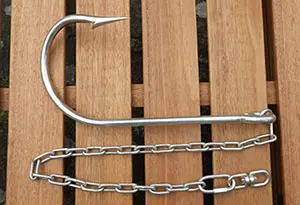
C. GAFFS & NETS
Gaffs and nets used to boat or land a fish must not
exceed 8 feet (2.44 meters) in overall length. (When
fishing from a bridge, pier or other high stationary
structure, this length limitation does not apply.) The
use of a flying gaff is not permitted. Only a single
hook is permitted on any gaff. Harpoon or lance attachments
are prohibited. A rope or any extension cannot be attached
to the gaff.
:: Angling Regulations ::
1) The angler must cast, hook, fight, and bring the
fish to gaff or net unaided by any other person. No
other person may touch any part of the tackle during
the playing of the fish or give aid other than taking
the leader for gaffing or netting purposes.
2) Casting and retrieving must be carried out in accordance
with normal customs and generally accepted practices.
The major criterion in casting is that the weight of
the line must carry the lure rather than the weight
of the lure carrying the line. Trolling a lure behind
a moving water craft is not permitted. The craft must
be completely out of gear both at the time the fly is
presented to the fish and during the retrieve.
3) Once a fish is hooked, the tackle may not be altered
in any way, with the exception of adding an extension
butt.
4) Fish must be hooked on the lure in use. If a small
fish takes the lure and a larger fish swallows the smaller
fish, the catch will be disallowed.
5) One or more people may assist in gaffing or netting
the fish.
6) The angling and equipment regulations shall apply
until the fish is weighed.
The following acts will disqualify
a catch:
1) Failure to comply with equipment or angling regulations.
2) The act of persons other than the angler in touching
any part if the rod, reel, or line either bodily or
with any device during the playing of the fish, or in
giving any aid other than that allowed in the rules
and regulations. If an obstacle to the passage of the
line through the rod guides has to be removed from the
line, then the obstacle shall he held and cut free.
Under no circumstances should the line be held or touched
by anyone other than the angler during this process.
3) Resting the rod on any part of the boat, or on any
other object while playing the fish.
4) Handlining or using a handline or rope attached
in any manner to the angler's line or leader for the
purpose of holding or lifting the fish.
5) Intentionally foul-hooking or snagging the fish
6) Shooting, harpooning, or lancing any fish (including
sharks and halibut) at any stage of the catch.
7) Chumming with the flesh, blood, skin, or any part
of mammals.
8) Using a boat or device to beach or drive a fish
into shallow water in order to deprive the fish of its
normal ability to swim.
9) Attaching the angler's line or leader to part of
the boat or other object for the purpose of holding
or lifting the fish.
10) If a fish escapes before gaffing, or netting and
is recaptured by any method other than as outlined in
the angling rules.
11) When a rod breaks (while the fish is being played)
in a manner that reduces its length below minimum dimensions
or severely impairs its angling characteristics.
12) When a fish is hooked or entangled on more than
one line.
13) Mutilation to the fish, prior to landing or boating
the catch, caused by sharks, other fish, mammals, or
propellers that remove or penetrate the flesh. (Injuries
caused by leader or line, scratches, old healed scars
or regeneration deformities are not considered to be
disqualifying injuries.) Any mutilation on the fish
must he shown in a photograph and fully explained in
a separate report accompanying the record application.