
Crimping or swaging as it sometimes
called is a quick and reliable method for making joins in
monofilament and cable. However some of the techniques are
misunderstood and fish are often lost due to poorly made crimped
connections. After you’ve read this you’ll be
building leaders that are the envy of your fishing buddies.
Remember, practice makes perfect. Learn
these methods at home when the weather’s too bad for
fishing and never lose another fish to a bad connection.
::
Sleeve styles ::
There are three main types of crimp sleeve in common
use. 1. Round section
2. Oval section
3. Double barrel
Round section
The less said about these the better. They are usually
made from brass and are compressed with a point to cup
type crimp tool. They don’t make a strong join
but are just about adequate for some light tackle applications.
If you’re desperate and can’t tie a knot
use these.
Oval section
This style is in almost universal use on commercial
longline vessels, and they catch some pretty big fish
using them. They are available in various brass and
copper alloys and in aluminium and you will need a cup
to cup type crimp tool to compress them. These are an
excellent choice for serious anglers. When appropriately
sized for the leader in use and compressed with the
correct tool they create a very strong and reliable
connection. Bear in mind though that in saltwater two
dissimilar metals can set up a corrosive reaction and
if aluminium sleeves are used to join steel cable they
will corrode away in a remarkably short period of time,
just like the sacrificial anodes used on sea going boats.
For this reason aluminium sleeves should only be used
for joining monofilament, whilst brass or copper sleeves
can be used for joining either monofilament or cable.
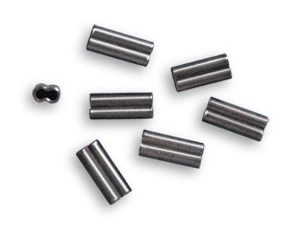
Double barrel
Double barrel sleeves are my favourite. They make a
strong neat join and there is no danger of the cable
or monofilament crossing over itself inside the sleeve.
They are also in common use on longline boats, but
due to being very slightly more costly than oval sleeves
they are less popular. Longliners use an awful lot of
sleeves so every cent saved is important, but that’s
not really such an issue for charter captains or private
anglers who use far fewer.
Like oval sleeves, double barrel sleeves are available
in both brass or copper and in aluminium. They should
also only be compressed with a cup to cup style crimping
tool.
The same comments regarding corrosion apply as for
oval sleeves. It’s important so I’ll say
it again. Use aluminium sleeves for monofilament only,
use brass or copper sleeves for either monofilament
or steel cable.
Double barrel sleeves are available in both standard
and heavy-duty models. The standard sleeves are only
available in brass or copper, whilst the heavy-duty
sleeves are available in brass, copper and aluminium.
These heavy-duty sleeves are for use with heavier leaders
and larger crimping tools and are often generically
referred to as ‘Nicopress’ sleeves.
:: Crimping tool styles
::
Left hand Point to Cup,
right hand cup to cup
There are four major types of crimping tool that you
are likely to see.
1. Point to cup
2. Cup to cup standard duty
3. Cup to cup heavy duty
4. Cup to cup bench press
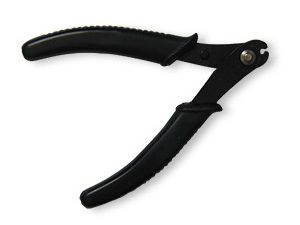
Point to cup
These tools can be purchased relatively cheaply from
tackle shops around the world. They resemble a large
pair of pliers with semi circular cut outs on one jaw
and a series of pointed teeth on the opposite jaw which
match up with the opposing cups.
They are used with round section crimp sleeves and
they roughly flatten the sleeve around the leader without
forming fully around the leader.
They make a very inadequate connection and are not
suited to rigging for big fish. I guess you can tell
that I don’t much like these.
Cup to cup
I’ll discuss these together because the principle
is the same for all of them.
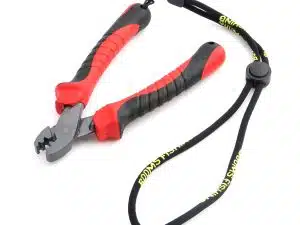
Again they resemble a large pair of pliers, but the
opposing jaws have matching pairs of semi circular cut
outs (the cups). There are usually three or four different
sized cut outs depending on the brand of tool.The jaws
usually have markings to indicate the appropriate sized
sleeves to use with each cut out. Each cut out will
usually accommodate several different sized sleeves
either oval section or double barrel.
Standard duty tool
These usually accommodate standard sleeves up to around
2.0 mm — 2.2 mm diameter, good enough for 300
— 400 lb monofilament or 600 lb cable. For most
anglers this should be all you’ll ever need.
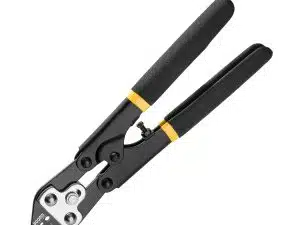
Heavy duty tool
These are a more costly version of the standard tool,
built to much heavier standards and capable of handling
standard and heavy duty sleeves as large as any angler
is ever likely to need. These are usually found on charter
boats, in tackle shops and in the workshops of serious
heavy tackle anglers.
Bench press tool
These use pretty much the same jaws as the heavy duty
tools but have an extended handle and are bench mounted
to facilitate crimping large quantities of heavy sleeves.
They are not portable and are reasonably expensive so
are usually only used by tackle companies, some larger
tackle shops and commercial longline vessels.
:: Making a basic crimped connection
in monofilament ::
Take your monofilament leader and select a suitable
sleeve. This can be alloy or copper, oval or double
barrel, whatever you like, but it should fit snugly
over the mono whilst still sliding easily.
Pass the mono through the sleeve, make a loop and pass
it back through the sleeve in the opposite direction.
Pull an extra 2 or 3 inches through the sleeve.
Take a cigarette lighter and melt the tag end of the
mono. When it softens and starts to turn into a ball
press the melted end against the lighter or other hard
surface to spread and flatten it.
Pull the leader back through the sleeve and the flattened
mono end will sit snugly against the end of the sleeve
without pulling back through. Now you can adjust the
size of the loop.
Left correct
note the uncompressed centre section
and the flared ends of sleeve. Right incorrect
the sleeve has been compressed in the
wrong direction damaging the monofilament
Take your crimp tool and select the appropriate cut
out to suit your sleeve. Position the sleeve between
the jaws of the tool so that the concave faces of the
cups bear against the curved edges of the sleeve. Do
not crimp all the way to the ends of the sleeve as this
will cause the edge of the sleeve to cut into the monofilament.
Make sure that you have left about 1/16 inch (1.6 mm)
between the end of the sleeve and the tool.
Squeeze the tool tightly closed and the sleeve should
compress around the monofilament. If using a small sleeve
you will only need to crimp it once, but larger sleeves
may require that you move the tool along and crimp it
once or twice more along its length. If possible leave
a 1/16 inch (1.6 mm) space between each compressed portion
of the sleeve, and the same at each end. The sleeve
should have a flared appearance at each end.
If using this technique to attach hooks, swivels or
any kind of anti chafe tube or loop protector you’ll
need to remember to thread the leader through them before
passing it back through the sleeve and crimping it closed.
:: Making a basic crimped connection
in cable ::
Making a crimped connection in cable is pretty much
the same as with monofilament, but there are a couple
of important differences.
1. Use brass or copper sleeves only. It doesn’t
matter whether they’re oval or double barrel.
2. Ensure that you don’t leave an exposed tag
end of wire, this can cut you badly when you are leadering
a fish. You may need to use a second sleeve crimped
over the tag end to achieve this, just pass a couple
of extra inches of leader through the first sleeve before
crimping it tight. Then either wrap the tag end around
the main leader before crimping them with the second
sleeve, or if you’re feeling clever you can haywire
twist the two lengths of cable before crimping.
:: Common crimping mistakes
::
1. Crimping all the
way to the end of the sleeve This causes the edge
of the sleeve to cut into the monofilament, always leave
about 1/16 inch (1.6 mm ) uncrimped at each end of the
sleeve.
2. Using alloy sleeves
on stainless steel cable
As previously mentioned this causes rapid corrosion
of the alloy sleeve quickly weakening the joint.
3. Using the wrong size
sleeve It’s pretty much impossible to use too
small a sleeve, the leader just won’t fit inside
it. However it is possible to use too large a sleeve.
The purpose of crimping is to deform the metal of the
sleeve around the leader and not to simply crush the
crimp until it touches the leader in as many places
as possible. Choose a sleeve that is a comfortable snug
fit on your chosen leader material.
Using the wrong tool
will cause the joint to fail under pressure
4. Not using the correct crimping
tool for the sleeves in use or not using a crimping
tool at all We’ve all met the guy
who isn’t prepared to waste his hard earned Dollars
on the right tool for the job. He says that he can do
just as good a job with pliers, a bench vice, a hammer,
his hands, his teeth or whatever.
Well they can’t, that’s the beginning and
the end of it.
Monofilament will be damaged by all these methods and
whilst cable is more forgiving the individual strands
can also be damaged. These methods will produce a joint
that sometimes holds up to average fish but will fail
when pushed to the limit.
When you consider that a standard crimp tool costs
less than 1/20 of the price of a standard trolling charter
and should last at least 10 years it seems a false economy
to use anything else.
I’ve never seen a correctly crimped connection
fail. Fish can be lost for all sorts of reasons but
this needn’t be one of them.
Right
Wrong
5. Using the correct tool
incorrectly
Many people think that a cup to cup crimping tool should
be used with the metal ridges between the semi circular
cups pressing into the central groove between the two
barrels of a double barrel sleeve or into the flat surfaces
of oval sleeves.
This is wrong, the pressure is exerted by the curved
surfaces of the cups against the curved sides of the
sleeve.
6. Leaving a tag end
protruding from the sleeve This isn’t a
big problem with monofilament although it does look
untidy and catches on weed and debris in the water.
If you can’t avoid a tag end use a crimp protector
to cover the join.
Cable is a different story though. A tag end of wire
can cut you badly when you are leadering a fish. Always
ensure that the tag ends are covered by a sleeve.
7. Not crimping the sleeve
Unbelievable but true, it’s very easy to be distracted
and forget to actually crimp the sleeve! I’ve
done it, but hopefully having read this you won’t!