
Skirted
offshore lures are now available in a confusing variety of
sizes, designs and colours. However most of these designs
break down in practical terms to one of the following basic
head shapes:
Bullet head
Chrome bullet head
BULLET HEADS are a straight tracking
lure. Depending on boat speed, the weight of the lure head
and the height from which the lure is pulled, they will occasionally
break the surface creating a bubble trail. Larger bullet heads
are normally heavily weighted and seldom surface, smaller
lighter heads do so more frequently.
Versions made from chromed brass with
jet holes ("jet heads") are popular and effective.
Bullet heads tend to get blown about in windy conditions as
they don’t hold the water well. Very attractive to tuna,
wahoo and dorado. Billfish will also often take these but
tend to prefer more active lures.
Flat face
FLAT HEADS. This head shape is cut at
90 degrees which causes the lure to track in a straight line,
coming up at regular intervals to make a splash or "pop"
before diving and carrying a long bubble or "smoke"
trail.
The length and size of the smoke trail
is determined by the diameter of the lure head (the same is
true, incidentally of all lures, not just flat faces). The
larger the diameter of the lure head or face, the longer and
wider the smoke trail. Most flat face lures hold the water
well, those with tapered heads being particularly good performers
in poor sea conditions.
Chugger
CHUGGERS. These are flat face heads
with a concave pocket scooped out of the face. These designs
cling to the water very well and work particularly well in
windy or marginal sea conditions.
The cupped face also causes the lure to swim with a distinct
head shaking action which may be very tight or much more active
and exaggerated depending on the lure's design.
SLANT FACE HEADS. Are split into two
basic categories.
Pusher bait
PUSHER BAITS - which are designed to
run on or close to the surface with an aggressive action,
"pushing" lots of water, hence the name. These heads
tend to have sharply angled faces and little or no taper.
In fact the earliest versions were moulded in straight-sided
glasses and cut at a sharp angle. Also known as straight runners.
Straight-sided models are often called "tube baits".
Usually do not run well in poor sea conditions, strong wind
or chop, but one of the most proven fish raisers in calm to
moderate seas because of the impressive pushing action.
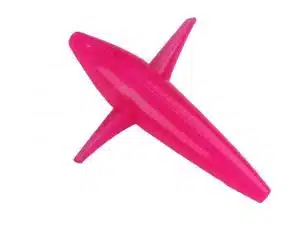
Taper bait
Plunger bait
"TAPER BAITS" - which
have a tapered nose and run beneath the surface most of the
time with a long smoke trail, breaking the surface at regular
intervals with a splash or pop, the aggressiveness of which
is determined by the size and the angle of its face. Longer
headed taper baits are popularly known as "plungers".
More versatile than pusher baits, taper baits and plungers
are still ideally suited to fairly smooth seas but some designs,
depending on size, positioning, weight and shape, will perform
in all but the most demanding conditions.
Lure selection
Selecting between these lure shapes, as has been hinted at,
is primarily determined by sea conditions. In rough weather
areas such as the Azores, flat and cupped face lures tend
to be widely used. Boats targeting marlin in the calm waters
of Kona and Madeira, on the other hand, tend to favour more
aggressive plungers, tubes and straight runners. Using this
guide as a starting point vary your lure style until you find
the most suitable for the prevailing sea conditions in your
waters.