
There are actually several kinds of strip baits you
can make although the best known here in Thailand is
the Panama strip bait, cut from the belly section of
a Dolphin, small Tuna or Rainbow runner. These are extremely
tough, an excellent choice for fly fishing teasers.
Florida strip baits are cut from the belly section of
small Tuna or Dolphin in a willow leaf shape. These
need pin rigs to hold them properly and are not very
popular although Phil Watkins, skipper of 'Wahoo' at
Phuket feels that they can be even more effective than
Panama strips. I have also seen Florida strips cut from
Squid, very interesting. Lastly, Mullet strips. These
are cut from the flank of a Mullet much like a fillet,
but including half a tail (much like cutting the tail
of a split-tail Mullet).
2 First catch your bait
Fresh bait is by far the best. Tuna deteriorates very
quickly. When I was at Phuket, we would run small squids
or bonito feathers on the way out to the sailfish grounds
in order to catch small tuna and school dolphin. Use
very small lures and light leaders for maximum success.
3 Ice your bait
You have to ice down the bait in order to make the
flesh more firm. If you cut the tuna straight away,
the meat is too soft. Lay the bait on ice for about
one hour. You can also cut the belly section and salt
it and lay it on ice, but I prefer to lay the whole
fish on ice and then cut it after it's chilled.
4 Cutting the belly section
Some people prefer to cut their tuna in front of the
anal fin and finish off just behind the pectoral fins.
I prefer to begin the cut just behind the anal fin and
carry on all the way to the throat latch. This gives
several advantages. The throat latch meat is extremely
tough and strong. The pectoral fins also act to stabilize
the bait.
Some Australian deckhands actually stitch the pectoral
fins so they stick out like the wings of a flying fish.
I don't recommend this unless you are trolling hookless
teasers for fly fishing. The stuck-out fins make it
hard for the fish to swallow the bait. Lastly, you can
cut out the anal fin once the belly is cut out, creating
a forked tail which wiggles appealingly.
Florida strip baits are cut in willow leaf form from
the belly meat. If you are going to make Florida strips,
cut out as much of the belly section as you can. For
Panama strips, cut a slimmer profile.
Knives must be very sharp. The edges of the strip baits
have
to be cut very cleanly.
5 Hooks and leaders
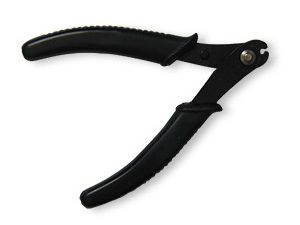
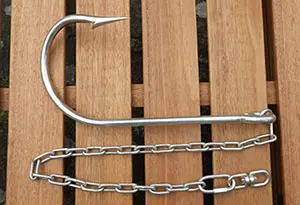
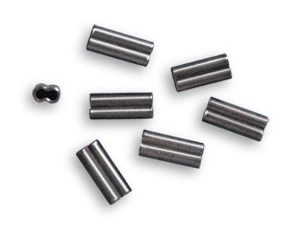
For Panama baits, simply crimp a length of cable or
mono leader to the hook and finish the other end as
normal. Cable is better when there are lots of toothy
critters about. For shy sailfish, we sometimes have
to drop down to 80 pound mono in order to get strikes.
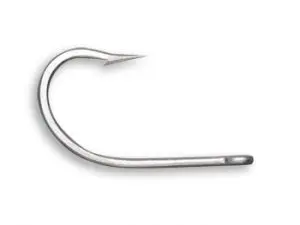
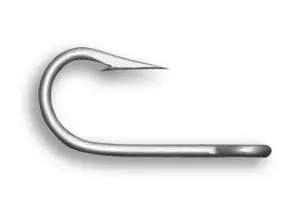
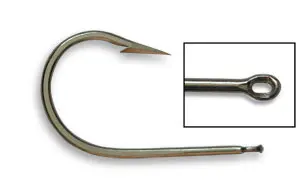
Hooks for Panama rigs need to be fairly large to clear
the bait when it's stitched. I like a 7/0 to 8/0 O'Shaughnessy
(Mustad 34007) because it's easy to sharpen and penetrate
on light tackle. If you are preparing the bait for King
mackerel or other toothy fish, use gang hooks. Florida
strips are smaller, so use a smaller hook. A 5/0 or
6/0 Mustad 10827BLN live bait pattern is excellent.
You will also have to twist some heavy wire on the hook
shank to pin the strip and hold the bait in the water.
6 Stitching the Panama bait
Panama baits are stitched together edge to edge. The
best stitching string is Dacron. Failing that, use cotton.
Pull out an adequate length of string and pass the needle
through the cartilage right at the front of the bait
above the pectoral fins. This is the strongest part
of the bait.
Pass the needle through the leader loop. Repeat, the
loop, not the eye of the hook. Pass the needle out the
other side of the bait. Stitches should go across the
bait and enter the bait from the other side. Some people
stitch the bait all the way down to the tail. I prefer
to stitch until where the hook comes out of the bait,
leaving a forked tail for more wiggle. Stitch back up.
The stitches must close the bait firmly and be deep
enough so that they cannot easily be torn out. The stitch
pattern along the top of the bait should look like a
row of Xs.
Note 1: Do not drive the hook through the belly of
the bait. The hook should lay on top of the bait with
the hook facing the other way. When the bait is stitched,
the hook point rides up. This procedure sounds intimidating
but it's easy in practice. After you have done a few
you should get the hang of it.
Note 2: If you are making a teaser for fly fishing,
make extra stitches to hold the bait together and also
around the leader loop to avoid the teaser being torn
off by a hungry fish.
Note 3: The best needles to use for all bait rigging
are the Stainless steel type with three cutting edges,
known as Morticians needles.
7 Florida strips
These are simply be pinned on to the wire. Run the
hook through the strip bait so that it runs flat otherwise
the strip will twist when trolled.
8 Striking procedure
If the strip baits are rigged with gang hooks for mackerel,
set the reel in strike drag and try and hook them up
instantly. For sailfish, using mono leaders with single
hooks, set the reel drag light. Let the fish take out
line until it's running quickly, then push the reel
to strike and reel until line is coming off under drag
tension, then strike a several times.
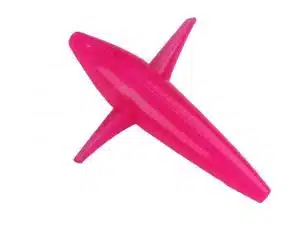
9 Squid skirts
These can be quite useful for tracking the baits more
easily. You can also pull a strip bait faster with the
squid skirt. Bright colours like pink, fluoro green
and orange are excellent. Sailfish seem to like pink
skirts. Choose a squid big enough to accomodate the
head of the bait. Sometimes, a squid skirt with an egg
sinker stuffed into the head is useful for making the
strip bait run below the surface. Good for king mackerel,
but I like a surface-running bait for Sailfish.
10 Fresh baits
Change your baits regularly. Panama baits can last
for about 2 hours before losing flavour, but replace
them every hour if you can. Sailfish in particular respond
much better to good, fresh baits.